
Introduction
ChatGPT Does Not Use a Simple Business Leaderboard
Traditional search engines return a list of links, ordered by a ranking system that businesses can study and influence over time. ChatGPT works differently. OpenAI has stated that ChatGPT Search ranks results using several factors intended to surface relevant and reliable information, but placement is never guaranteed. Rather than presenting a static list, ChatGPT synthesizes an answer from what it already knows and, when web search is enabled, from what it retrieves at the moment of the question. That is why the same question can produce different businesses in different conversations.
Two Sources Feed That Impression
ChatGPT draws on two broad sources of information. The first is its training data, the large body of text the model learned from before it was ever deployed, which can include websites, articles, reviews, and public discussion, though not every source type necessarily formed part of any given model's training. The second is real-time web search, used when a question needs current information such as opening hours, pricing, or recent news. When search is active, ChatGPT can browse the web, review what it finds, and cite the sources it actually used.
These two sources do not always agree. A business might be described one way in older training data and differently on its current website. For time-sensitive questions, web retrieval can provide newer information than the model's underlying knowledge, though OpenAI has not published documentation establishing a specific weighting between the two.
Why Recommend Is a Misleading Word
The word recommend suggests a preference, but ChatGPT does not have opinions in the way a person does. A business is not selected through a publicly documented recommendation formula. Instead, ChatGPT generates an answer based on the information available to it and, when Search is used, the sources it retrieves and finds relevant to the question being asked.
The Beliefs ChatGPT Needs Before Naming a Business
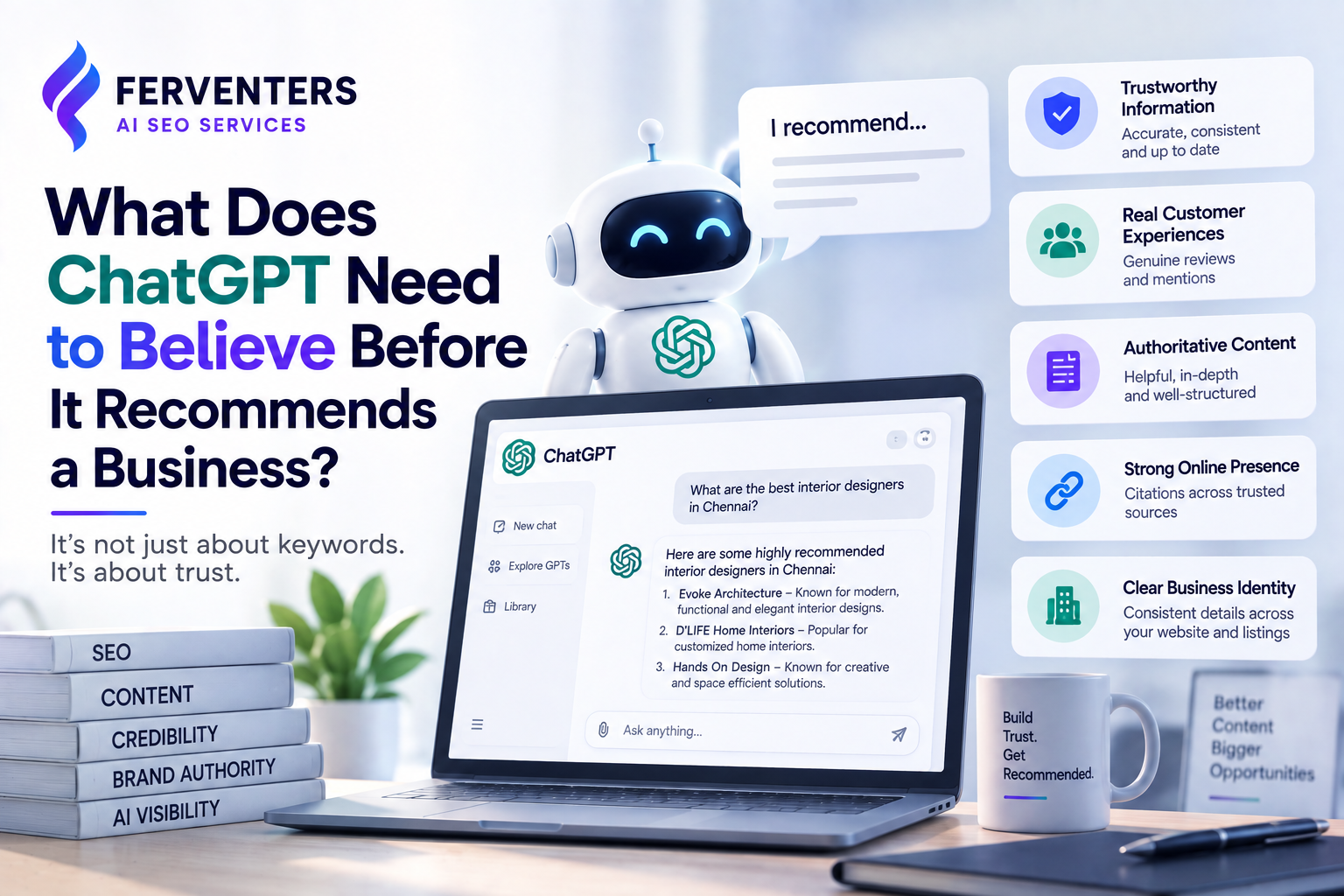
Several conditions tend to appear together whenever a business shows up in an AI-generated answer, based on how OpenAI and independent researchers describe the underlying mechanics.
That the Business Is a Clear, Distinct Entity
ChatGPT needs to understand what a business is, what it does, and where it operates. If a brand name overlaps with another company, or if a website describes the business inconsistently across different pages, the model has a harder time treating it as a single, well-defined entity worth naming.
That Independent Sources Describe It Consistently
A business's own website is one data point, not proof on its own. Consistent information across independent sources, such as directories, review platforms, and news coverage, gives an AI system more consistent evidence with which to identify and describe a business, compared with a business that only exists in its own marketing materials.
That the Business Has Demonstrated Real Expertise
Generic marketing pages rarely carry much weight. Content that goes into genuine depth on a topic, answers specific questions, and reflects real practical knowledge gives the model more to work with than a page that simply states the business is the best in its field. A law firm with a dozen detailed articles on a specific area of employment law, for instance, offers more usable substance than a homepage that only lists services in bullet points.
Why a Business's Own Claims Carry Less Weight Alone
Any business can write that it offers excellent service. Independent, third-party material, such as reviews, media mentions, or references from other credible sources, is not something the business controls directly, which is part of why it tends to be treated as more useful supporting context.
What Can Work Against That Belief
Just as certain patterns tend to build confidence, others can quietly work against a business without anyone noticing why.
Conflicting Information Across the Web
Different addresses, phone numbers, or service descriptions across a website, a directory listing, and a social profile create confusion rather than clarity. When sources disagree, an AI system has less consistent material to draw from when describing that business.
Thin Content With No Depth Behind It
A handful of shallow pages that repeat the same generic claims give the model little to retrieve or reference. Depth and specificity tend to matter more than volume.
Little Discoverable Information Beyond the Business's Own Website
If a business has little discoverable information beyond its own website, there may be less independent material available for an AI system to reference or use as corroborating context, regardless of how polished that website looks.
How This Differs From Traditional Search Visibility
Traditional search visibility is influenced by many signals, including relevance, content quality, links, technical accessibility, and other page- and site-level factors. This does not mean traditional SEO becomes irrelevant. Google continues to emphasize that its foundational SEO guidance remains relevant for its generative AI search features, including AI Overviews and AI Mode. What changes with tools like ChatGPT is less about ranking a single page and more about resolving which business an entity refers to and retrieving passages that answer a specific question.
Because the mechanics differ, treating SEO for large language models as a simple extension of traditional SEO tends to miss the point. It requires paying attention to entity consistency, third-party context, and content that can be understood and cross-checked independently of the business's own claims, alongside the technical and content fundamentals that already apply to conventional search.
Making a Website Easier to Find and Verify
Businesses that show up consistently in AI-generated answers tend to share a few structural habits, rather than a single trick.
Make the Website Accessible to ChatGPT Search
Technical accessibility is a prerequisite for web visibility. OpenAI recommends allowing OAI-SearchBot to crawl a website for publishers who want their content to be discoverable, surfaced, cited, and linked within ChatGPT Search. Businesses should also confirm that their hosting or content delivery network permits traffic from OpenAI's published search bot addresses, since a blocked crawler cannot retrieve a page regardless of how well that page is written.
Structured Data That Machines Can Parse
Structured data such as Organization, LocalBusiness, or FAQPage schema does not guarantee a mention in an AI answer, and there is no published OpenAI rule making schema markup a requirement for appearing in ChatGPT results. Structured data can help search engines understand information about a page and its entities, which supports overall clarity even where it cannot be confirmed as a direct ChatGPT ranking factor.
Third-Party Context
Reviews on relevant platforms, along with mentions in trade publications or local news, can provide publicly available information about a business beyond its own website. OpenAI has not published a rule stating that reviews directly trigger recommendations, but this kind of independent material adds to the pool of information an AI system may draw on.
Content That Stays Current
Outdated pages, old pricing, or stale service lists can create uncertainty, since an AI system has no reliable way to know whether that information still holds true. Keeping core business details current across a website and its listings reduces that uncertainty.
What to Measure
Because there is no public dashboard showing exactly why a business was or was not mentioned, tracking a handful of practical signals over time is more useful than chasing a single metric. Businesses allowing OAI-SearchBot can also review referral traffic from ChatGPT, including visits tagged with the utm_source=chatgpt.com parameter, in their web analytics. Worth monitoring on a regular basis:
● Brand mentions across AI-generated answers for relevant questions
● How competitors are described in the same types of answers
● Which sources are cited alongside or instead of the business
● Whether the business's services and location are described accurately
● Referral traffic arriving from ChatGPT in analytics tools
What Businesses Can Reasonably Expect
OpenAI has not published a complete formula that explains exactly how ChatGPT selects businesses to mention, and no agency or tool can guarantee a specific outcome. What is reasonable to expect is that consistent, accurate information across the web gives an AI system more reliable material to work with than a single highly optimized page on its own. That does not guarantee inclusion in any particular answer, but it does give a business more usable evidence across the many questions being asked every day.
It also helps to remember that retrieval is dynamic rather than fixed. The same question asked twice, from two different locations or phrased slightly differently, can surface different businesses depending on what gets retrieved at that moment.
Conclusion
ChatGPT does not choose a favorite business the way a person might. It works from whatever information it can find and reference in the moment, and it forms something like a working belief about who a business is and whether that business is a credible option to mention. Businesses that want to show up in these answers need to focus less on gaming a ranking system and more on becoming genuinely easy to find, understand, and verify. If you want help auditing where the gaps are in your own AI visibility, you can Contact us to walk through what the current evidence says about your business.
Frequently Asked Questions
Does ChatGPT rank businesses the same way Google does?
Google Search uses many signals to determine which results are relevant and useful for a query. ChatGPT Search also uses multiple factors to rank search results, but the experience is designed around synthesizing retrieved information into an answer rather than simply presenting a conventional list of links.
Can paying for ads get a business recommended by ChatGPT?
There is no confirmed mechanism for businesses to pay directly for organic inclusion in a ChatGPT answer. OpenAI states that Search placement is based on factors intended to surface relevant, reliable information, and that placement is not guaranteed.
Do reviews actually influence what ChatGPT says about a business?
Reviews can provide publicly available information about a business, but OpenAI has not published a rule saying that reviews directly trigger recommendations. They remain one part of the broader pool of independent material an AI system may reference.
Is structured data necessary to appear in ChatGPT answers?
Structured data can help search engines understand information on a page, but there is no published OpenAI rule making schema markup a requirement for appearing in ChatGPT answers.
How is this different from regular search engine optimization?
Regular search optimization focuses on ranking a page higher in a results list using signals such as relevance, content quality, and links. Optimizing for AI answers adds a focus on entity clarity, technical accessibility for AI crawlers, and content that can be cross-checked rather than simply read, on top of the fundamentals that already apply to conventional search.
Found this post insightful? Don't forget to share it with your network!
Written by
Kamal Selvam
0
Publication Date
2026-09-15
Reading Time
10 min read
Category
Author Name
Kamal Selvam
Table of Contents
- •
- •
- •
- •
- •
- •
- •
- •
- •
- •