1. Two Halves of the Same Mandate
2. The Execution Gap That Sinks Most Programs
3. Strategy Sets Direction, Visibility Proves It
4. The Machine-Readable Brand
5. A Shared Operating Model
6. Metrics That Connect the Two
Frequently Asked Questions

2. The Execution Gap That Sinks Most Programs
3. Strategy Sets Direction, Visibility Proves It
4. The Machine-Readable Brand
5. A Shared Operating Model
6. Metrics That Connect the Two
Frequently Asked Questions
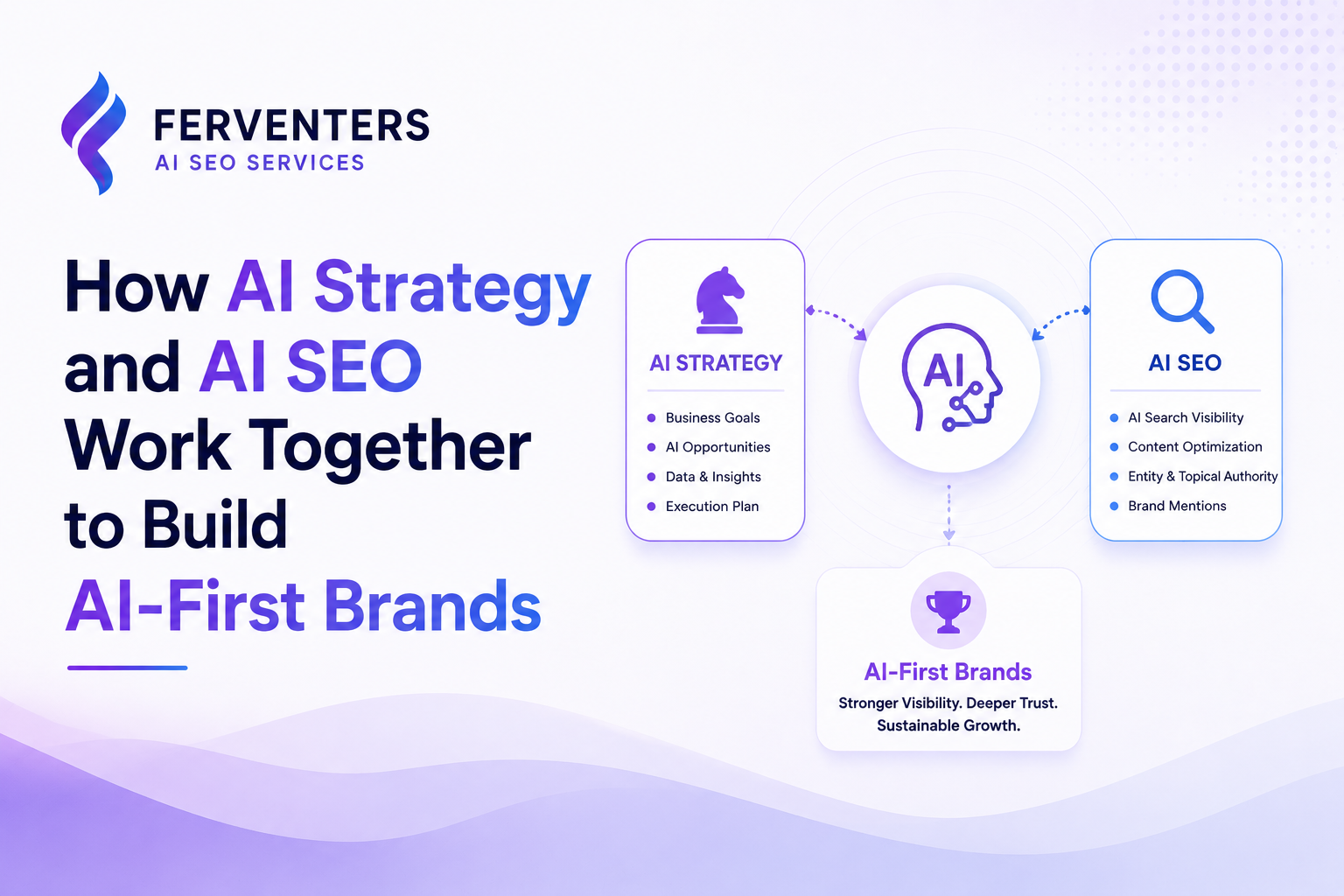
The two disciplines are often confused, so it helps to define them. The higher-level plan decides where intelligent systems create advantage across products, operations, and go-to-market. The visibility discipline ensures that when a buyer asks an assistant for a recommendation, the brand is understood, trusted, and named. One sets intent; the other secures that the intent reaches the market.
Treating them separately is the common failure. A company can build an ambitious roadmap and still be absent from the answers its customers receive, because internal capability and external legibility are different problems. A brand can also chase citations with no strategic thesis and end up visible for things that do not matter to its economics. The two only compound their impact when designed as a single loop.
The core idea The executive plan determines where AI creates a competitive advantage. AI SEO makes that advantage discoverable to the AI systems buyers increasingly trust. Neither survives on its own. Direction without discoverability stays invisible; discoverability without direction wins the wrong queries. |
The evidence on stalled initiatives explains why so many well-funded efforts underdeliver. Research through 2026 has documented how rarely experiments reach production and how often value never materializes.
Finding | Figure | Source |
Proofs of concept that never reach production | 88% | IDC, 2026 |
Enterprise pilots failing to deliver ROI | 95% | MIT Project NANDA, 2025 |
Marketing teams with no roadmap for the technology | 64% | Trade Press Services, 2026 |
Firms with a fully integrated company-wide plan | 3.8% | Keepler State of AI, 2026 |
The bottleneck is rarely the technology. It sits in the foundation beneath it: fragmented data, misaligned leadership, and teams adding capabilities on top of infrastructure never designed for them. Gartner has forecast that organizations will abandon a large share of projects that lack the ready data to support them. Visibility work faces the same trap. Bolting answer-engine tactics onto a brand with no clear positioning produces motion without momentum, so direction must come first and discoverability has to be engineered deliberately.
When an assistant lists three competitors and omits your brand, it is almost never a verdict on product quality. It is usually one of three diagnosable failures, each mapping to a different part of the combined effort.
The model has no consistent idea of what the brand is, so it cannot confidently name it. This is a positioning problem before it is a technical one. The strategic work of defining segment, category, and differentiation gives the model something coherent to learn, and clarifying that identity is where generative search optimization and executive planning genuinely overlap.
The brand is known, but its pages offer nothing structured enough to lift into an answer. This is an execution problem: unclear content, buried facts, and missing structure. The remedy is disciplined formatting and structured data that let a system quote the brand accurately.
Claims live only on the brand's own domain with nothing independent to confirm them, so the model declines to repeat them. This is a reputation problem that neither positioning nor page structure alone can fix. It requires earned coverage and consistent presence across the sources models trust.
A useful frame gaining ground in 2026 is the machine-readable brand: the idea that as autonomous agents increasingly act on behalf of buyers, the clarity of your data matters more than the polish of your interface. In agent-mediated commerce, three interaction modes are emerging, from consumer-to-brand agents to the more complex agent-to-agent negotiations, and each assumes your brand can be queried directly rather than browsed.
Practically, that means exposing verifiable facts, such as current pricing, availability, specifications, and identity, through structured formats an agent can consume without a human interface. Robust JSON-LD is the baseline, and emerging standards like the Model Context Protocol point toward agents querying brand identity as a service. If an agent cannot resolve what you offer through a clean data handshake, the brand is not in the decision loop. Building that foundation sits squarely inside agentic SEO services, which prepare a brand for buyers that are increasingly software.
Shared metrics are what keep strategy and visibility honest with each other. The trap most teams fall into is measuring correlation because it is achievable with the resources they have, while the actual job requires causal understanding of what moved an outcome. Automating a flawed measurement approach only scales the error.
A stronger scorecard blends both altitudes. Track how often the brand appears as a recommended answer across the major assistants and how accurately it is described, then connect that to pipeline quality and revenue rather than raw impressions. Because visitors referred by these AI systems tend to arrive pre-qualified, even modest gains in recommendation share can move the numbers leadership watches. Where possible, isolate cause with holdout groups and controlled tests, so investment flows to plays that genuinely work rather than ones that merely coincided with a good quarter. That discipline is the connective tissue between an answer engine optimization program and the business case that funds it.
What makes a brand AI-first rather than simply AI-enabled?
An AI-enabled brand uses the technology internally to work faster. An AI-first brand also designs its external presence, data, and positioning so that the models buyers consult can understand and recommend it. The distinction is internal efficiency versus external discoverability.
Which should come first, the strategic plan or the visibility work?
Direction comes first, but only just. A clear thesis on where you compete tells the visibility effort which queries and audiences matter, and the visibility data then feeds back to sharpen the strategy. In practice they are sequenced closely and revisited together.
Why do so many transformation programs fail to show results?
Most stall on foundations rather than technology. Fragmented data, absent roadmaps, and leadership misalignment are the recurring causes, which is why research consistently shows a large majority of pilots never reaching production or proving a return on investment.
Do smaller companies need an an agent-ready data layer yet?
Increasingly, yes. As buyers delegate research and comparison to assistants, structured and verifiable facts about your offering determine whether you appear in their shortlists. Starting early is cheaper than retrofitting later.
How do we measure whether the two efforts are working together?
Use a scorecard that links recommendation frequency and description accuracy in AI answers to pipeline and revenue. If visibility rises but quality pipeline does not, the strategy and the visibility work are targeting different things.
An AI-first brand is not built by a bold roadmap or a clever visibility campaign in isolation. It emerges when a clear strategic thesis and a rigorous discoverability practice are run as one loop, each correcting the other. Decide where intelligence gives you an edge, make that edge legible to the systems your buyers trust, measure the connection honestly, and repeat. The brands that master that loop in 2026 will not just be using the technology. They will be the answer it gives.
Turn AI ambition into market visibility Ferventers aligns executive AI strategy with the discoverability work that makes brands the recommended answer across assistants, from positioning through structured data to measurement. Ready to connect strategy and visibility? Contact us to map your path to an AI-first brand. |
Found this post insightful? Don't forget to share it with your network!
2026-07-30
10 min read
Kamal Selvam