AI SEO services in India help businesses stay visible and competitive in 2026 by optimizing their websites, content, and brand signals for AI-driven search systems such as ChatGPT, Google AI Overviews, Gemini, and other large language models. Unlike traditional SEO, which focuses mainly on rankings and traffic, AI SEO focuses on how machines understand, trust, and recommend brands during decision-making.

AI SEO Services in India: Complete Guide for 2026
Why AI SEO matters in India in 2026
Search behavior has fundamentally changed.
In India, users are no longer relying only on Google search results to make decisions. Business owners, marketing teams, and even procurement managers now ask AI tools questions like:
-
Which company should I choose?
-
What is the best service provider for my requirement?
-
Compare options and suggest the safest choice.
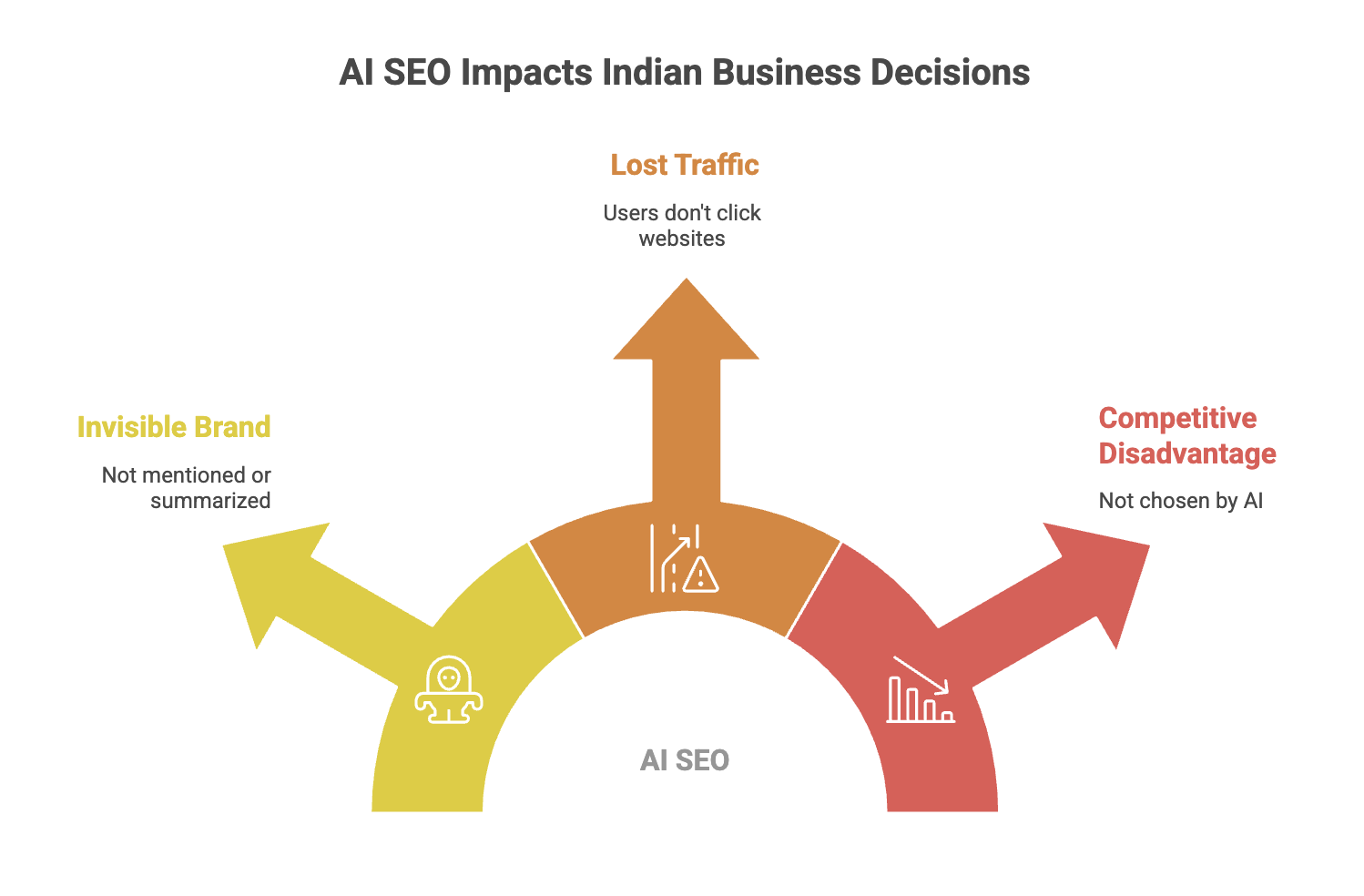
AI systems answer these questions directly. In many cases, users never click a website at all. If your brand is not mentioned, summarized, or cited by AI, you are invisible at the moment of decision.
This shift makes AI SEO critical for Indian businesses competing in crowded markets such as IT services, SaaS, consulting, healthcare, real estate, and e-commerce.
What are AI SEO services?
AI SEO services are strategies designed to make a business understandable, trustworthy, and retrievable by AI systems.
Instead of optimizing only for keywords, AI SEO focuses on:
-
1. Clear brand and service definitions
-
2. Structured, answer-friendly content
-
3. Entity clarity and topical authority
-
4. Trust and consistency across the website
The goal is not just to rank pages, but to ensure AI tools confidently reference your brand when answering user questions.
AI SEO vs traditional SEO
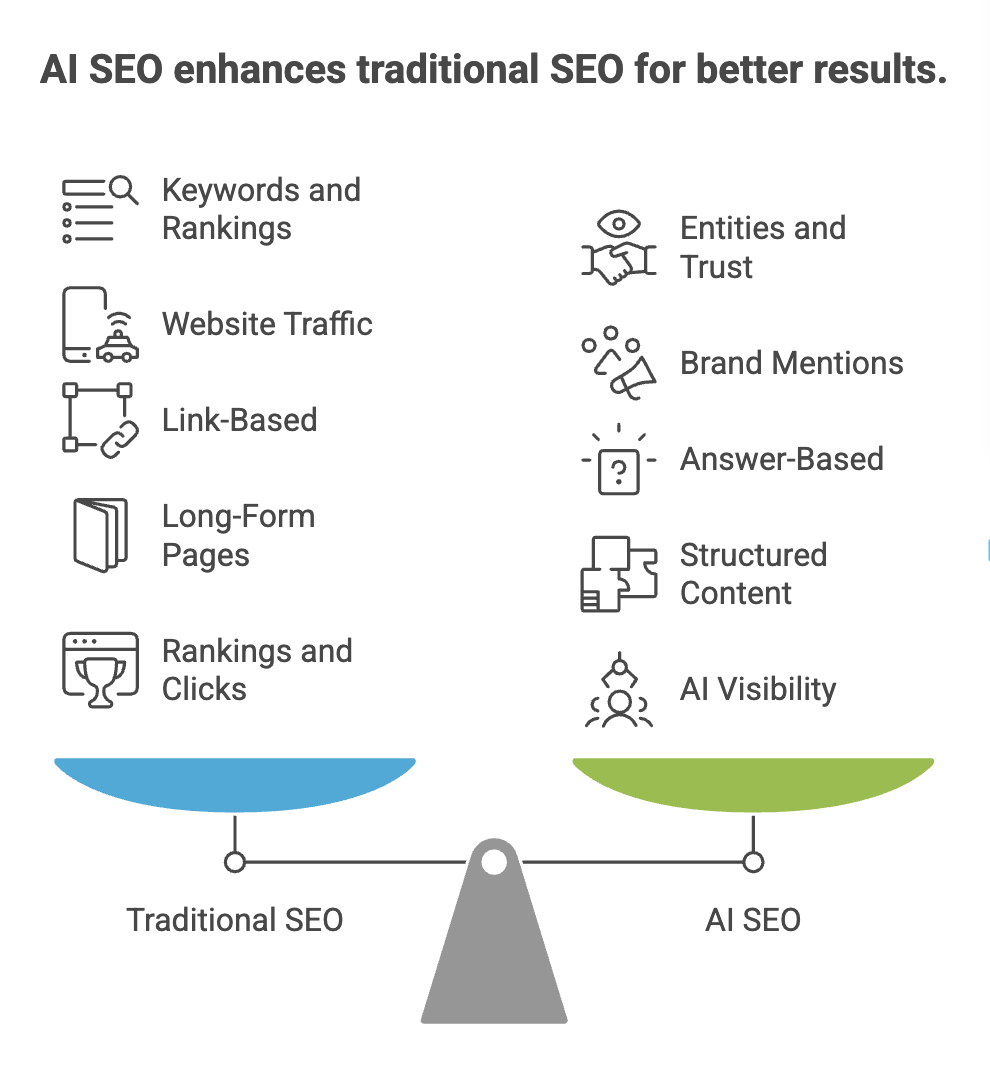
| Aspect | Traditional SEO | AI SEO |
| Core focus | Keywords and rankings | Entities and trust |
| Primary output | Website traffic | Brand mentions and citations |
| Search behavior | Link-based | Answer-based |
| Content style | Long-form pages | Structured, quotable content |
| Success metric | Rankings, clicks | AI visibility, assisted conversions |
Traditional SEO is still important, but in 2026 it works best when combined with AI SEO.
How AI SEO services work
1. AI search intent analysis
AI SEO starts by studying how users ask questions inside AI tools. These are conversational, comparison-driven, and decision-focused queries, not short keywords.
2. Brand and entity definition
Your business is clearly defined as an entity. Services, industries, locations, and expertise are consistently described so AI systems know exactly who you are and what you offer.
3. Content restructuring
Existing pages are rewritten into AI-friendly formats using direct answers, short explanations, FAQs, tables, and clear sections that machines can easily extract.
4. Authority and trust alignment
Experience, consistency, and clarity are reinforced across content so AI systems view the brand as reliable.
5. Internal signal strengthening
Topical clusters and contextual internal linking are used to show depth and relevance within a subject area.
6. AI visibility validation
Fixed prompt tests are run across AI tools to check whether the brand appears, how it is described, and where gaps exist.
While many businesses understand the importance of AI visibility, executing these strategies consistently requires specialized expertise. Implementing entity optimization, restructuring content for AI extraction, and validating visibility across multiple AI tools is not a one-time task. This is where working with teams that offer dedicated AI SEO services becomes relevant. Instead of focusing only on rankings or traffic, such services help align content, brand signals, and topical authority so businesses remain discoverable inside AI-driven search systems as they evolve.
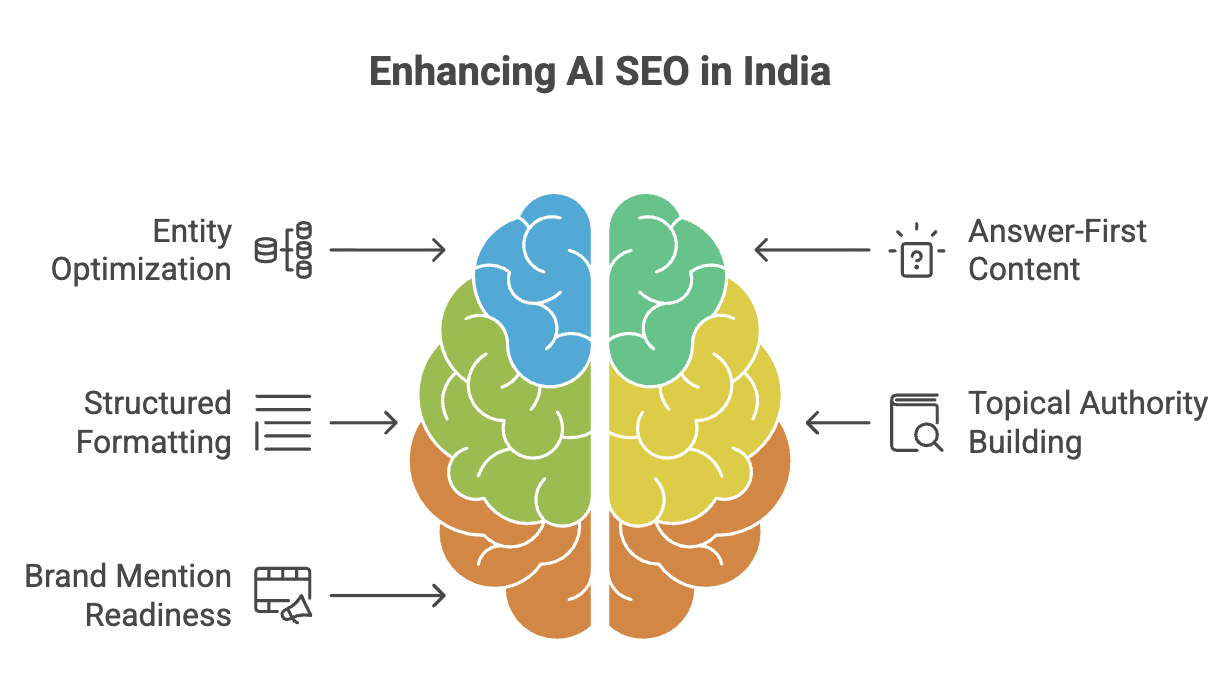
Core components of AI SEO services in India
Entity optimization
AI systems rely on entities, not just keywords. Entity optimization ensures your brand, services, and locations are clearly connected and consistently presented.
Answer-first content
Pages are written to answer real questions immediately, followed by explanations. This improves AI extraction and citation likelihood.
Structured formatting
Tables, lists, FAQs, and clean headings help AI models understand and reuse content accurately.
Topical authority building
Instead of isolated posts, AI SEO builds topic clusters that signal subject-matter depth.
Brand mention readiness
AI SEO increases the probability that your brand is named directly when AI tools generate responses.
Common mistakes businesses make
Treating AI SEO as a tool instead of a strategy
-
Focusing only on keywords, not questions
-
Writing long introductions without clear answers
-
Inconsistent brand descriptions across pages
-
Publishing generic AI-generated content
-
Ignoring FAQs and structured sections
-
Measuring success only by traffic
-
Creating content without topical depth
-
Relying only on backlinks
-
Expecting instant results
Each of these weakens AI trust and visibility.
Tools typically used in AI SEO
| Purpose | Usage |
| Prompt testing | Check AI visibility |
| Search analysis | Understand query patterns |
| Content optimization | Improve structure and clarity |
| Tracking | Monitor mentions and citations |
Measuring AI SEO success
Key indicators
-
Brand mentions inside AI tools
-
Citation presence in AI answers
-
Coverage across buyer-intent prompts
-
Quality inbound leads
What success looks like
-
Your brand is named when AI recommends options
-
Reduced dependence on rankings alone
-
Higher trust-driven conversions
About Ferventers
Ferventers is an AI SEO agency in India focused on helping brands stay visible as search becomes increasingly AI-driven. Our work centers on entity optimization, AI-friendly content structuring, and long-term topical authority so businesses are discoverable where decisions actually happen in 2026.
Conclusion
AI SEO services in India are no longer optional. As AI tools increasingly influence buying decisions, businesses that optimize only for traditional SEO risk disappearing at the most critical moment. AI SEO ensures your brand is understood, trusted, and recommended by the systems people now rely on to choose.
FAQs
What is AI SEO?
AI SEO optimizes content and brands for visibility inside AI-powered search and answer engines.
Is AI SEO different from SEO?
Yes. SEO focuses on rankings. AI SEO focuses on citations and recommendations.
Do Indian businesses need AI SEO in 2026?
Yes. AI tools now influence vendor shortlisting and decisions.
Does AI SEO replace traditional SEO?
No. It complements and extends it.
How long does AI SEO take to show results?
Initial visibility can appear in weeks. Authority compounds over months.
Is AI SEO expensive?
Costs vary, but it often delivers higher-intent visibility than traditional SEO alone.
Can small businesses use AI SEO?
Yes, especially service-based and niche businesses.
Does AI SEO guarantee ChatGPT mentions?
No guarantees, but it significantly improves likelihood.
Is content still important in AI SEO?
Yes, but structure and clarity matter more than length alone.
Is AI SEO future-proof?
It aligns with how search is evolving, making it more future-resilient.
Found this post insightful? Don't forget to share it with your network!
Written by
Kamal Selvam
21
Publication Date
2026-01-26
Reading Time
10 min read
Category
Author Name
Kamal Selvam
Table of Contents
- •
- •
- •
- •
- •
- •
- •
- •
- •
- •
- •
- •